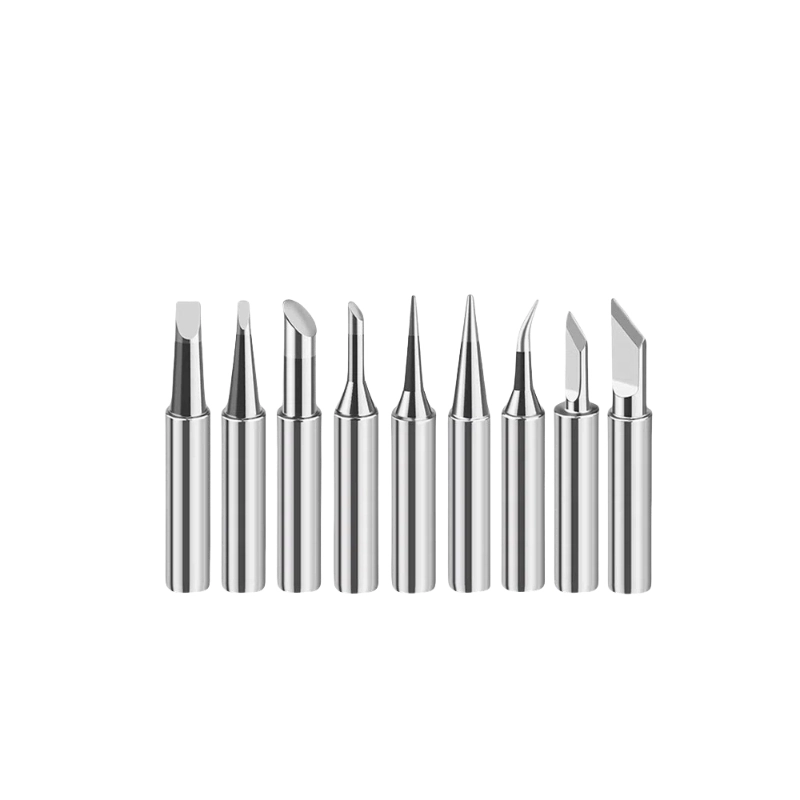
Lead free 900M series soldering iron tips for 936 soldering station
Direct replacement 900M soldering tip for Hakko FX-888D / 936. 6.5mm OD, 4.1mm ID, 42mm length. 4500-min pulse nano electroplating. Request bulk pricing.
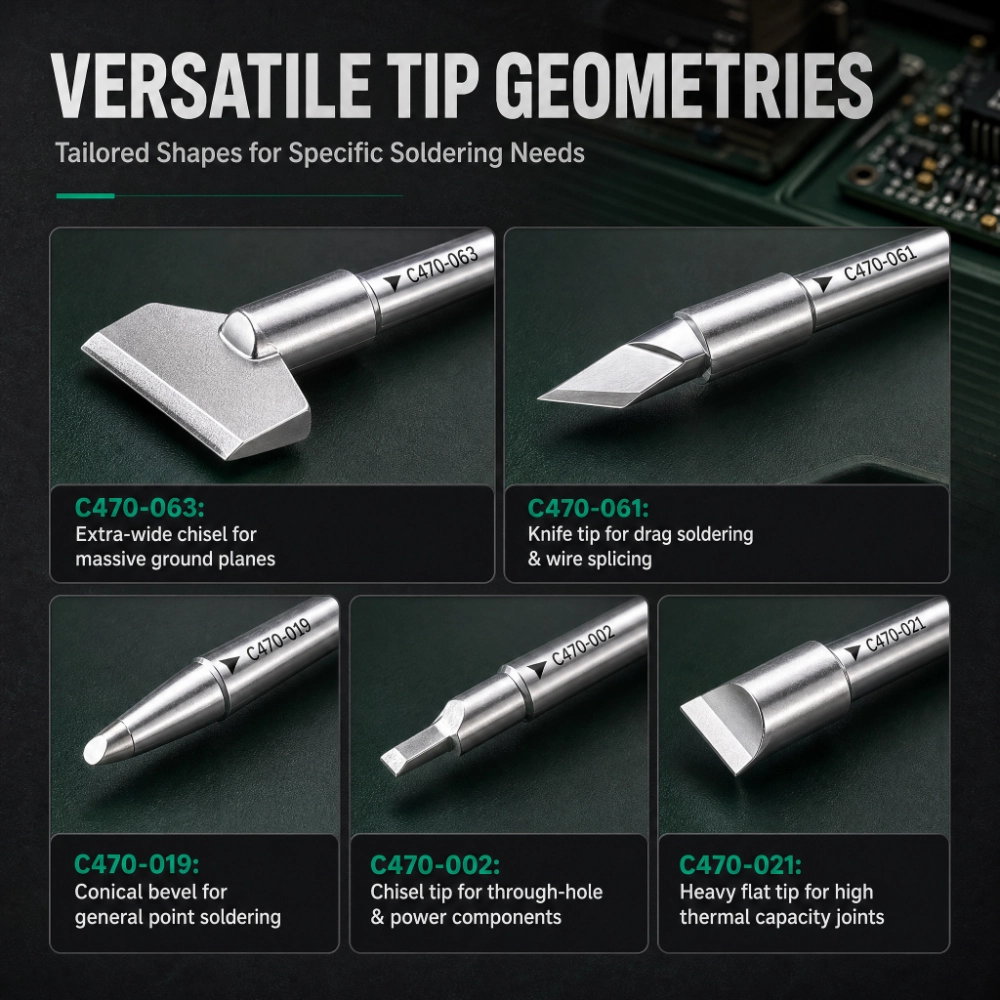
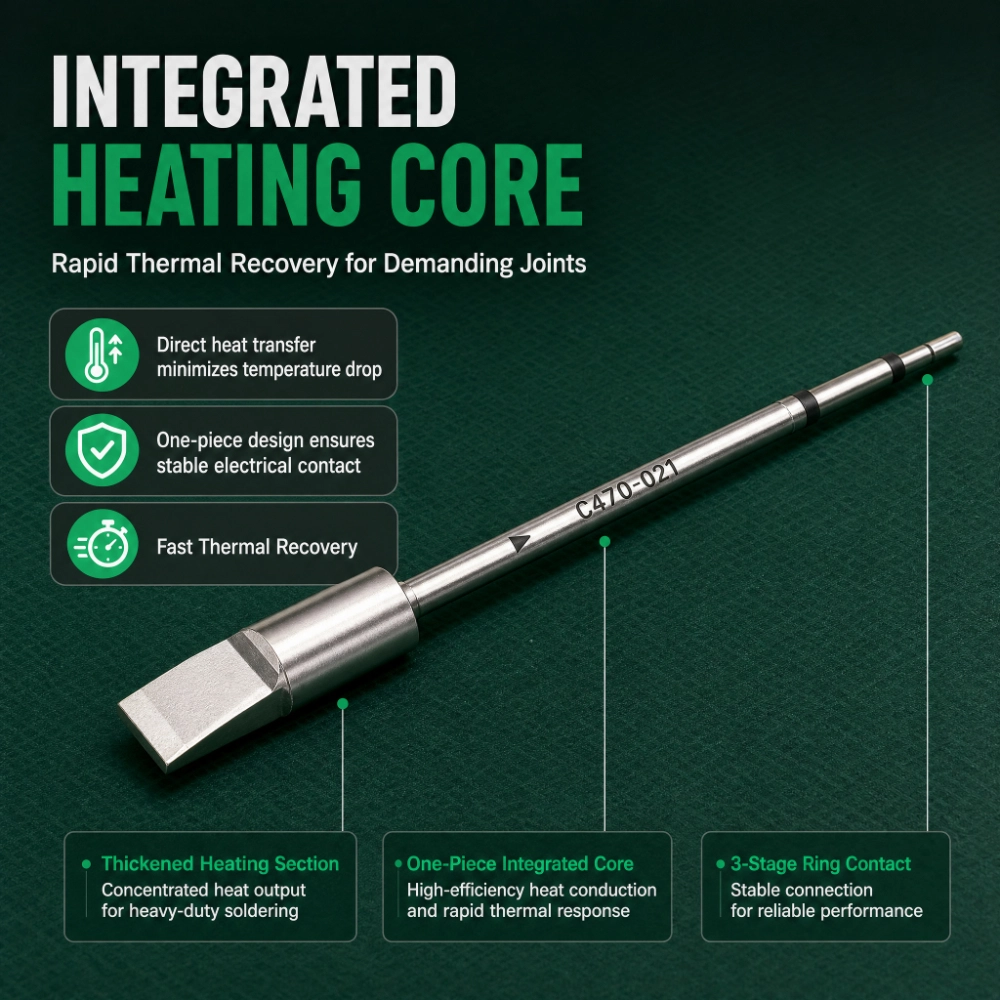
View productThe C470 series heavy-duty tip is built for JBC HDE and HD class stations and seats on the T470 handpiece, and this guide walks through what a buyer needs before a first order: geometry, plating, fit, service life and the practical limits of any replacement tip. If you are sourcing custom soldering tips for a proprietary handpiece, the intake requirements and build sequence below show exactly how tooling is specified and validated. Working with a soldering iron kit manufacturer lets you match barrel length, heater placement and plating stack to the station you already run, instead of accepting whatever geometry happens to be on the shelf.
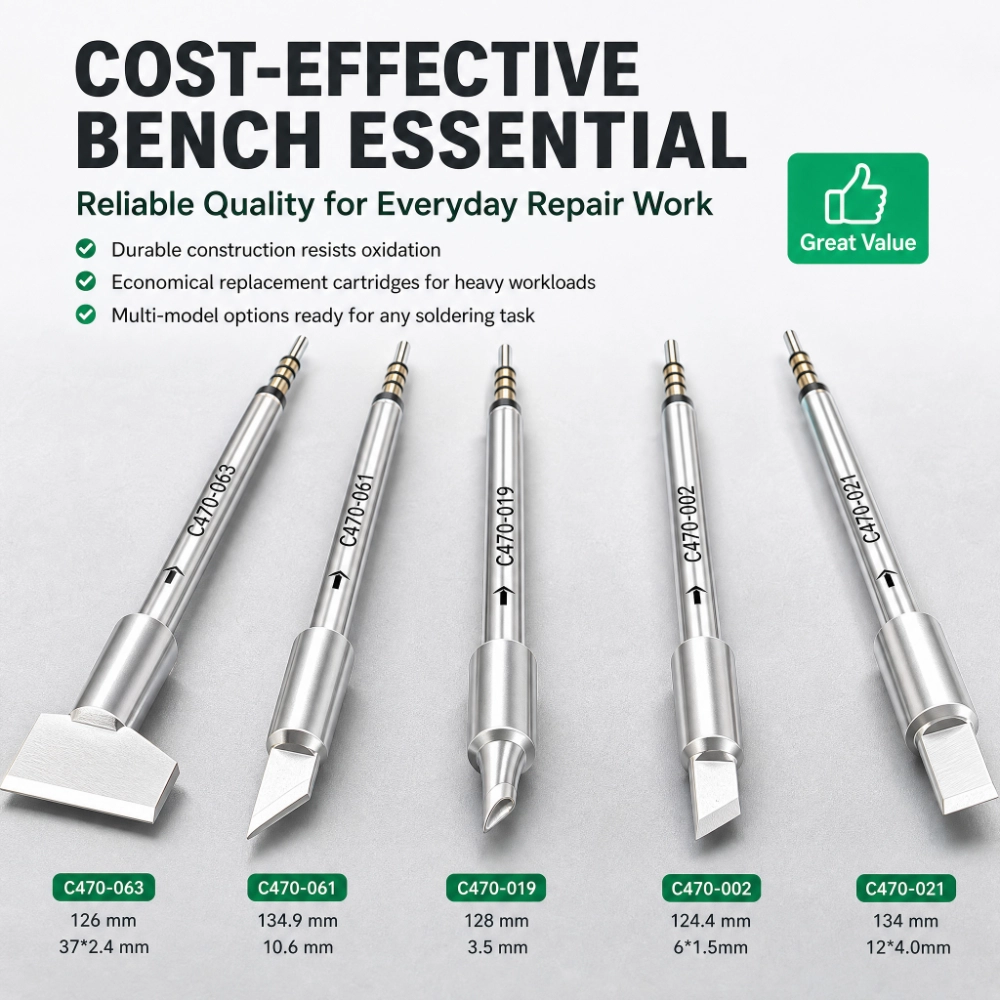
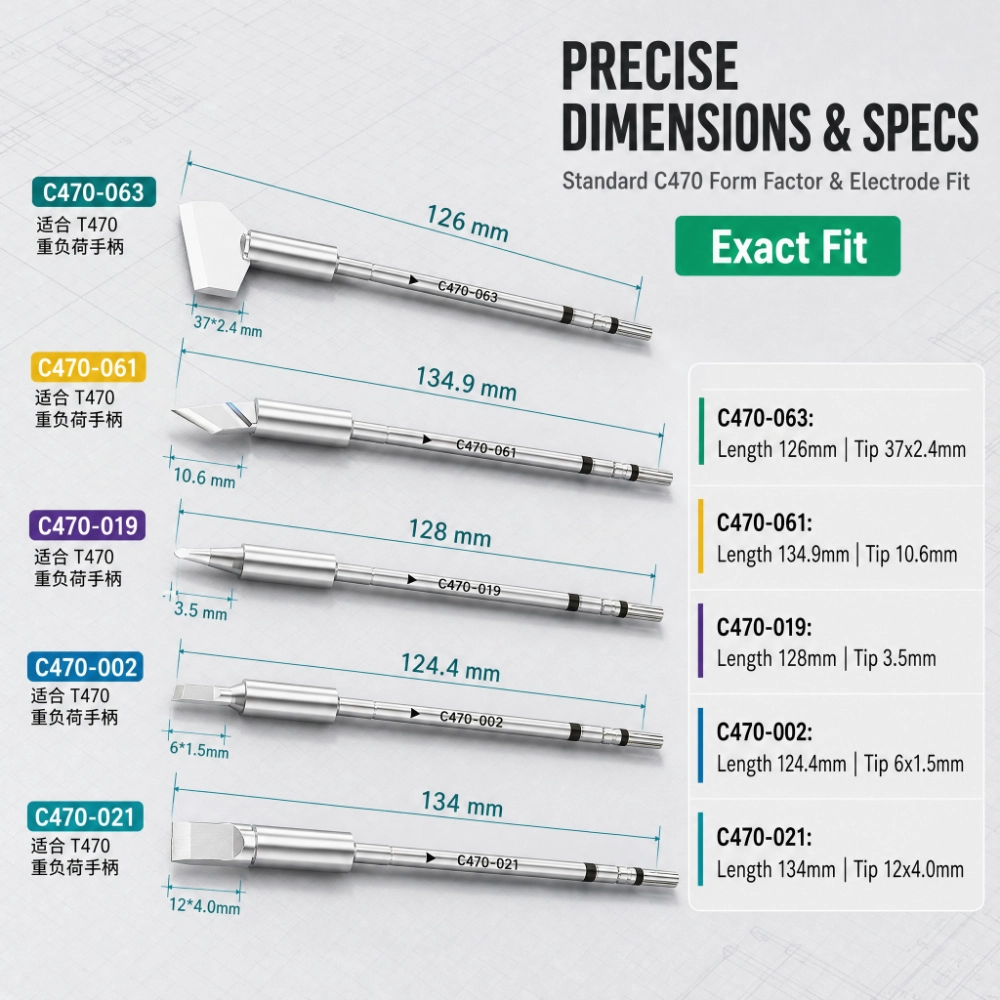
The C470 series is a heavy-duty tip family for JBC HDE-2UD, HDE-2E, HDE-1, HD and HDCT stations, and it fits the T470 handpiece. It is not a general-purpose hobby tip: the barrel is designed for large ground pads, high-power terminals and shielding cans, where a small precision tip simply cannot push enough heat into the joint.
These are the values that determine whether a replacement tip will behave like the original: how fast heat moves into the joint, how tightly the heater seats inside the barrel, and how the plating stack resists wear.
| Parameter | Value |
|---|---|
| Copper core material | C1020 oxygen-free copper, copper content ≥ 99.95% |
| Electrical conductivity | ≥ 98.5% |
| Thermal conductivity | Approx. 390–400 W/(m·K) |
| Inner wall surface roughness | ≤ Ra0.8 |
| Heating element ceramic | Aluminium nitride ceramic |
| Heating wire | FeCrAl alloy |
| Thermocouple | High-precision K-type, thermal lag approx. 0.3 seconds |
| Plating process | 144-hour nano-composite electroplating, four functional layers |
| Station compatibility | JBC HDE-2UD, HDE-2E, HDE-1, HD, HDCT; T470 handpiece |
Five stages carry the tip from raw copper to a plated, solder-ready component. Each stage exists to protect one property: heat transfer, heater contact, temperature stability or wear resistance.
Copper content of at least 99.95% forms the body that carries heat from the heater bore to the working end.
The inner wall is finished to ≤ Ra0.8 so the heating element seats with maximum contact and minimal air gap.
AlN ceramic is chosen for ultra-fast thermal conduction into the copper body, which shortens recovery time between joints.
The alloy resists deformation at high temperature, so heat output stays stable across the working life of the tip.
Four functional layers are applied: an iron layer at 18 A/dm², a 10 μm nickel layer, hard chromium at 15 A/dm², and a 12 μm tin layer pre-applied to the working end.
Heavy-duty tips fail early for one of two reasons: the wrong geometry is used on a large thermal mass, or the station is run hotter than the plating can tolerate. Both are buying decisions, not manufacturing defects.
Product fact: the series is designed for large ground pads and heat-sink tabs, where the copper mass pulls heat out of the joint faster than a narrow tip can replace it.
Buyer decision: specify the widest barrel geometry available in the series and confirm the working end makes full flat contact with the pad.
Product fact: the C470 is listed for high-power wire harness and terminal soldering, and the recommended lead-free band is 350 °C ± 10 °C.
Buyer decision: hold the station inside that band and check that the barrel reaches the terminal base rather than resting on the wire insulation.
Product fact: the series covers metal housing grounding and shielding can soldering, a duty cycle that keeps the tip in contact with a large metal mass.
Buyer decision: budget for shorter inspection intervals here than on small pads, because continuous contact with heavy metal accelerates plating wear.
Product fact: the tip is also intended for removal of heavy components, where dwell time is longer than in normal production soldering.
Buyer decision: order a spare tip per rework station so a worn tip never forces a line stoppage mid-shift.
Custom work is a trade, not a request. The left column lists what can be engineered to your requirement; the right column lists the inputs that make a first-article sample possible without guesswork.
Service life is quoted at 20,000–48,000 solder joints, but that range only holds when the plating is protected. The difference between the top and bottom of that range is usually cleaning habit and set temperature.
Volume discounts and custom tip shapes or plating specifications are available for qualified buyers, and technical datasheets or wholesale inquiries can be requested directly. The contact form accepts a name, email, phone or WhatsApp number, and a document upload field for design drawings.
Keep adjacent product options together for a faster catalog comparison.
Direct replacement 900M soldering tip for Hakko FX-888D / 936. 6.5mm OD, 4.1mm ID, 42mm length. 4500-min pulse nano electroplating. Request bulk pricing.
View product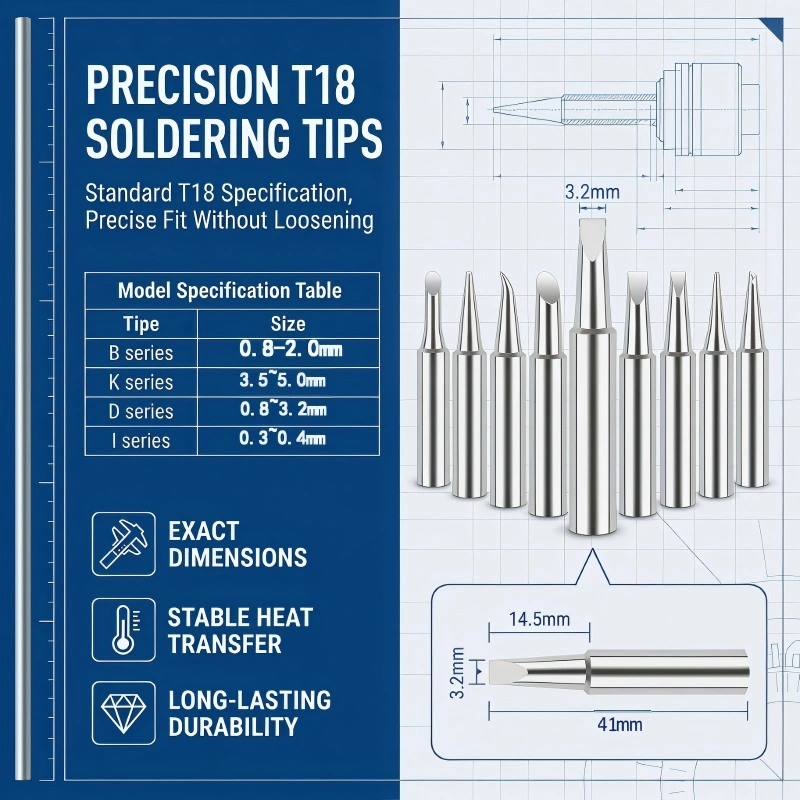
Manufacturer of soldering tips supplier with copper core material and factory direct service. Ideal for FX888D soldering iron parts and kits.
View product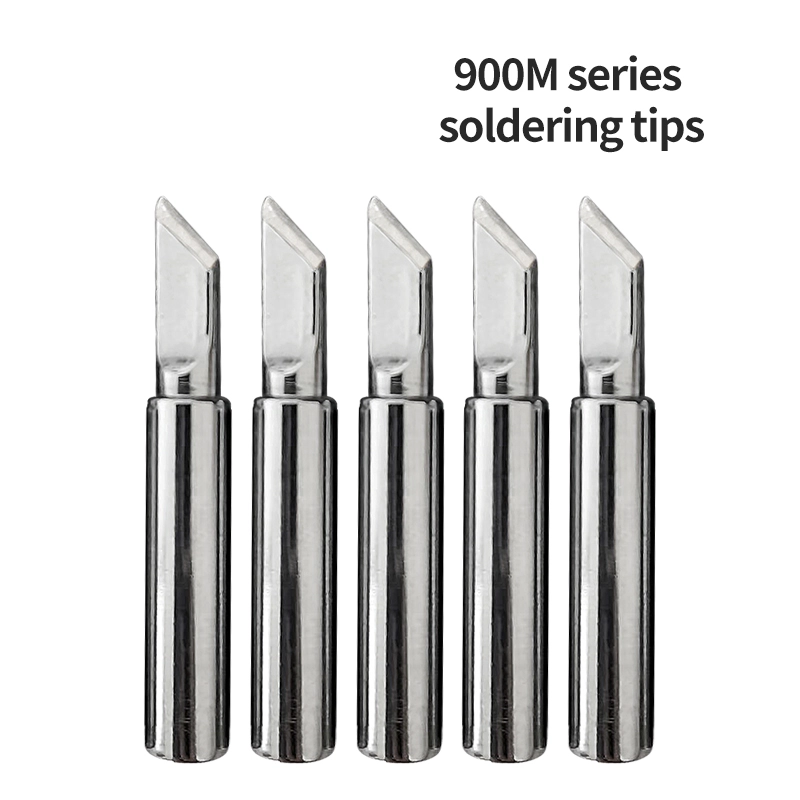
Manufacturer of soldering iron tips with copper core material. Offers custom soldering tips and factory direct supply for BGA rework.
View productThe series is listed for jbc hde-2ud, hde-2e, hde-1, hd and hdct stations, and it is fully compatible with the t470 handpiece. Overall tip length is approximately 123 mm, which is what creates the secure contact with that handpiece.
The core is c1020 oxygen-free copper with a copper content of at least 99.95%, an electrical conductivity of 98.5% or higher and a thermal conductivity of roughly 390–400 w/(m·k). That combination is what moves heat from the ceramic heater into the working end quickly enough for heavy joints.
Service life is stated at 20,000–48,000 solder joints under standard conditions of 350–400 °c with proper maintenance. Actual life depends on operating temperature, flux and solder alloy, so a tip run above the recommended band will sit at the lower end of that range.
Use 350 °c ± 10 °c for lead-free solder and 320 °c ± 10 °c for leaded solder. Alongside temperature control, clean the tip with a damp sponge or brass wire ball during use and apply a solder tin cap before powering the station off.
The product page states 30–50% savings against genuine jbc c470 tips, with consistent quality across production batches. The saving is measured per tip, so the practical gain depends on how close you keep the tip to its stated service life.
Volume discounts and custom tip shapes or plating specifications are available for qualified buyers. Send a cad file or dimensioned drawing, your station model, heater wattage, target joint temperature, solder alloy and estimated annual volume through the contact page, which also accepts a document upload for design drawings.